John Christow's murder
The HollowJohn Christow's murder is the central violent event of The Hollow, converting the Angkatell family's apparently playful poolside tableau into a genuine crime scene. John Christow is shot beside the swimming pool at The Hollow just as he imagines that he has escaped the burdens of his past and can begin again; his death then becomes the occasion for competing versions of his character, his relationships, and the household's responsibility to collide.
Causes and Background
Before the shooting, John Christow has just rejected Veronica Cray and feels, in the immediate aftermath, that he has started a new life. Walking back through the wood, he has no regret about treating Veronica harshly and regards ending their relationship as the best thing he has ever done. He thinks that he may now become kinder to Gerda Christow and stop trying to bully Henrietta Savernake, then resolves to go to Henrietta and tell her so. The murder therefore interrupts a moment of imagined moral renewal: John is not killed while fleeing his past, but while believing that the past has finally loosened its hold on him.
His medical identity gives the event an additional irony. In his consulting room, John Christow can appear wholly attentive, sympathetic, and encouraging to a patient, asking questions and offering directions so effectively that she leaves almost revived. Yet once she has gone, he forgets her almost completely; the healer's response has become automatic, and he feels the exhaustion produced by giving out strength. He is bored by cases that offer only palliation, but his work at St. Christopher's Hospital and his relationship with Mrs. Crabtree preserve his sense of purpose. Mrs. Crabtree, whom he considers a fighter, shares his zest for existence despite poverty, exhausting labor, an alcoholic husband, and unruly children. The contrast between his professional power and his private entanglements makes the killing more than a plot mechanism: the man who sustains life for others is suddenly reduced to a body that others must interpret.
What Happens at the Pool
John Christow sits on a bench by the swimming pool after walking through the wood. He hears the ordinary sounds of the woodland, including earlier shots higher in the wood, birds, and falling leaves, but then detects a faint, businesslike click. The sound makes him acutely conscious of danger. He realizes that someone is watching him and turns sharply, yet the attacker reacts faster. John’s eyes widen in surprise, but he has no time to make a sound before the shot rings out.
He falls awkwardly, sprawled at the edge of the pool. A dark stain slowly wells on his left side, runs onto the concrete, and drips red into the blue water. The measured movement of the blood gives the scene its terrible physical certainty: the pool, associated with leisure and display, becomes the surface that registers the murder. When John Christow opens his mouth, his final word is an urgent address to Henrietta Savernake. His eyelids then drop and his head jerks sideways; Hercule Poirot kneels, verifies the death, and states that John Christow is dead.
The Staged Scene and Its Recognition
Hercule Poirot initially encounters the scene as though it were a tasteless performance arranged for his amusement. He steps into the open space around the pool and stiffens with annoyance, believing that the Angkatells have produced an artificial set piece as a joke. The long walk, his disappointment at the house, and what he reads as the English sense of humor intensify his irritation. Gudgeon, however, is plainly not in on the supposed secret, a detail that begins to disturb the theatrical interpretation.
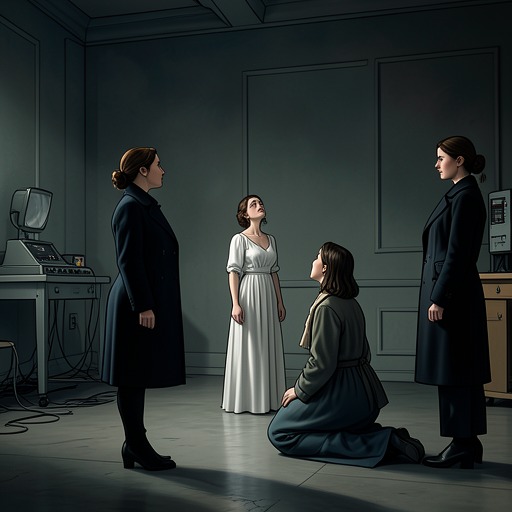
The decisive reversal comes when Poirot realizes that the artificial scene has a point of reality. The figure by the pool is not a painted prop or a harmless performance but a man who is dead or dying; the red substance is blood, and the shooting has occurred only moments earlier. The people gathered around John appear to Poirot like pale actors in a remote drama, while the dying man alone possesses vivid, undeniable reality. The murder thus depends on a sudden collapse of appearances: a scene first mistaken for theater becomes fact, and the witnesses are forced from spectatorship into implication.
Revelation of the Killer and the Method
The later confession of Gerda Christow identifies her as the killer. She says that she could not bear what John had become in her eyes and that she had to kill him. Her plan was not a spontaneous act alone but a deliberate attempt to exploit forensic firearm identification. After Sir Henry Angkatell had shown her how to load and fire a revolver, Gerda intended to use two revolvers: she would shoot John with one, hide it, and allow herself to be found holding the other. The discovery that John had not been killed by the revolver in her possession would, she believed, make the police conclude that she was innocent.
Gerda’s plan also explains the staged quality that initially misleads Poirot. The apparent absurdity of the poolside arrangement is connected to a calculated attempt to direct suspicion toward the wrong weapon and therefore the wrong interpretation of the evidence. Her knowledge comes partly from a detective story about police identifying the gun from which a bullet was fired. Yet she forgets the leather holster in the drawer of her bedroom. That overlooked object preserves a material trace of the plan and exposes the gap between her confidence in her cleverness and the incompleteness of her concealment.
Consequences and Significance
The murder destroys the household’s ordinary hierarchy. Lucy Angkatell’s charm has long allowed her to disregard rules, precedence, and even the social consequences of placing enemies together; Sir Henry observes that she repeatedly gets away with conduct that would be intolerable from anyone else. After John’s death, however, the same domestic system of indulgence becomes a mechanism for managing scandal. Gudgeon’s hesitation before Inspector Grange, his glance toward Sir Henry and the Inspector, and his eventual departure show the servants’ loyalty operating within the pressure of police authority. Later, when Gudgeon opens the car door at The Hollow, Lucy Angkatell thanks him and the other servants for the loyalty they have shown, confirming that the household has treated the crisis as a collective burden.
The investigation also exposes the class structure surrounding the crime. Inspector Grange notices Sir Henry’s distinguished bearing and his former position as Governor of the Hollowene Islands, while Sir Henry’s collection of firearms and his statement that the revolver was unloaded when put away become relevant to the inquiry. At the same time, Midge Hardcastle feels separated from Lucy Angkatell, Henry Angkatell, and Henrietta Savernake by an impassable gulf between the leisured and the working. The murder therefore occurs inside a social world whose members possess unequal access to comfort, authority, and concealment.
Finally, John’s death unsettles the public image of the man as decisively as it unsettles the physical household. Henrietta Savernake fears that newspapers will reduce him to a sensational account of a doctor’s love life involving Gerda Christow, herself, and Veronica Cray. She insists that women were not what mattered most to him; his work, its excitement, and its sense of adventure mattered more. In her account, Mrs. Crabtree would have been the woman most present in his mind, because she represented the fighting will to live that John recognized in himself. Mrs. Crabtree later remembers his demanding but encouraging treatment and the way he persuaded her that she could endure more, describing him as a doctor for whom she felt she must not fail. The murder consequently leaves behind two conflicting Johns: the difficult, controlling man entangled in old relationships, and the healer whose work gave his life its deepest energy. The crime’s lasting significance lies in the impossibility of separating those identities once his death has made every private loyalty part of the evidence.